
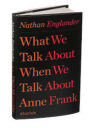
In 2012, I participated in a local project called “One Book, One Bay” where writers from around the Bay Area wrote essays on Nathan Englander’s book What We Talk About When We Talk About Anne Frank. The link to the essay I wrote left that website a long time ago, but I still love the essay I wrote about the story “How We Avenged the Blums.” It’s posted below.
What We Talk About When We Talk About Anne Frank
Which is more confusing: to be powerful, or to be powerless? Nathan Englander’s story How We Avenged the Blums is a story of how a young adolescent boy grapples with and understands this question in the context of a well-drilled Jewish education in Jewish victimization.
The story is about a group of young boys who are startled when one day, the youngest Blum boy is attacked and beaten by a peer they call “the Anti-Semite.” The boys themselves are intent on avenging this insult, but as they roam their adult community, they encounter a staggering variety of messages about how they should handle the challenge.
For instance, the Blum parents are second generation Americans, and call the police immediately. But our narrator, a boy as unnamed as the Anti-Semite, reports, “My parents wouldn’t have done it, and let that fact be known.” The difference between these positions seems to be the expectation of what could be done, and how rampant anti-Semitism is. Another character, Ace Cohen, a barely-adult “tough” Jew also agrees that the police shouldn’t have been called, but for a different reason; despite the fact that he could fight it, he thinks it’s better to let it go rather than escalate the matter. A Russian refusenik teaches martial arts in specially-created paid classes, while the Rabbis at school are led by the community to support a plan to arm the boys with the tools of self-defense.
The reader feels keenly the lack of community consensus around what should be done. No one knows what to do about this menacing bully who is targeting Jewish boys, or rather, everyone does: The Rabbi offers one bit of advice, contradicted by that of the policeman, the Jewish boy counted on to offer a punch refuses, and the mercenary Russian teaches fighting lessons, but flees before completing the boys’ training. The story uses these various voices to play with the possibilities of what to do.
Meanwhile, the boys singlemindedly pursue the one avenue apparently open to them: strengthening themselves, practicing skills of self-defense, and eventually mastering the art of attack.
The story seems at times to be an elaborate set-up for the final punch, in which the young bully is finally brought down. Lured to the playground, then attacked, he falls with a single punch from Ace Cohen. Now that they are victorious, they can do nothing more than stare. Englander writes, “With the Anti-Semite at our feet, confusion came over us all. We stood there looking at that crushed boy. And none of us knew when to run.”
That confusion is the deep essence of this story. The narrator of the story has not felt confusion up until this point, despite the many voices pointing in every direction. He has felt universally certain of the need for revenge. Now that he is looking at his adversary, writhing on the ground in defeat, “I knew I’d always feel that to be broken was better than to break– my failing.”
But while the narrator may come to this conclusion upon the defeat of his adversary, the reader is forced to a different conclusion, noticing that certainty has not fallen into moral disarray with the defeat of the bully. Rather, all along, the story has been a cacophony of voices, urging as many different solutions as there are characters.
But it is only once the nemesis is brought to the ground that his confusion now mirrors ours. He has unwittingly demonstrated that being the persecutor seems preferable only when you are the persecuted. To be powerful is a different sort of confusion, one that confuses morality with possibility, allowing us the illusion of deservedness.
In this story, neither power nor powerlessness avenges abuse. Both bring confusion, uncertainty, and misery, both for the adults in the community, and their younger reflections. If there is a lesson in this story, it is about the futility of trying to grow strong in response to power. In response to a bully, one can either learn to box or not learn to box, but the moral confusion does not abate. Trapped in a cycle of power and violence, both raising one’s fists and not raising one’s fists fail to resolve the ambiguity of what to do with a bully.
What is left for us is to consider why this story belongs in a compilation entitled What We Talk About When We Talk About Anne Frank. Several connections suggest themselves, not the least of which is that Anne Frank is a young girl the age of the protagonists who never had the chance they had to experiment with her own power or revenge. But perhaps more intriguing is the part of the Anne Frank story which she herself never recorded, because she couldn’t: the fate which led her family to hiding, and eventually led the Nazis to find and exterminate them.
Amidst a community of Jews who all struggled to find a way to protect themselves from the Nazi threat, we know that Anne’s family’s path was one of many possibilities. There were those who attempted confrontation, rebellion, cooperation, acquiescence, flight, and many others. Nobody knew what to do to save themselves and their families.
And in the end, there was no right answer, for, save for a small number of improbable stories, they all perished. The Frank family perished along with the Rabbi who showed up to meet the Nazis in Tallit and T’fillin and was shot on the spot. They perished along with those caught running away, and along with those who tried too late to convert. Along with those who organized and raised their fists and weapons and went down fighting. And along with those who trustingly gathered in town squares and were herded onto trains.
Truly, Englander’s point is well taken– there is great moral ambiguity in being in a position of power. What I think the story urges us to remember is that being in a position of powerlessness offers no beacon of light to the moral, safe, or correct path of action.
Ariella Radwin has a Ph.D. in Jewish Studies from UCLA’s Department of Near Eastern Languages and Cultures. Over the past several years, she has taught courses at Stanford University, the University of San Francisco, and San Francisco State University. She has also taught in various synagogue and community venues including Bible by the Bay, Limmud, Kevah, Jewbilee, and the Feast of Jewish Learning. She spends most of her time living and learning with her homeschooled children in Palo Alto.